Sadik Sagar, Dhaka:
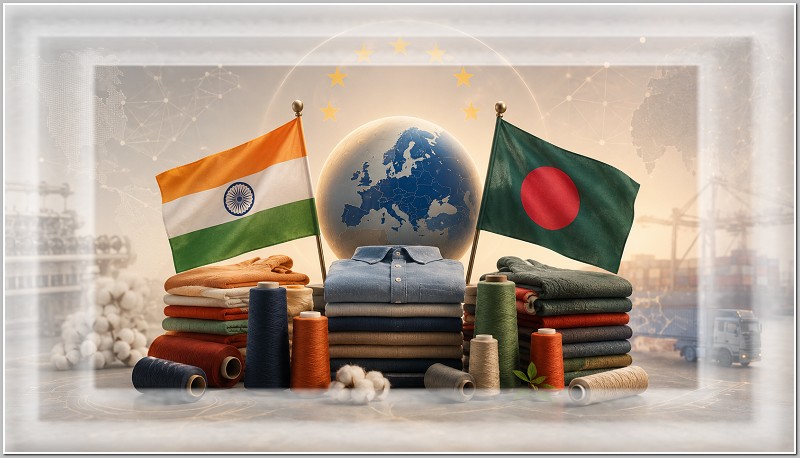
Bangladesh’s readymade garment (RMG) industry, long regarded as the backbone of the country’s export economy, is facing a new strategic challenge as India steadily strengthens its position in the European apparel market. While Bangladesh remains the second-largest apparel exporter globally and continues to enjoy a strong foothold in the European Union (EU), emerging trade agreements and structural advantages are positioning India as a formidable competitor in the coming years.
The growing concern centers on India’s ongoing Free Trade Agreement (FTA) negotiations with the EU, expected to be finalized by early 2027. Once implemented, Indian apparel and textile products are likely to gain duty-free access to the European market, eliminating tariffs currently ranging from 9 to 12 percent. At the same time, Bangladesh is preparing for its graduation from Least Developed Country (LDC) status, a transition that could eventually end its duty-free access under the EU’s Everything but Arms (EBA) scheme and expose its exports to tariffs of around 12 percent.
This shift could significantly alter the competitive landscape. Bangladesh’s success in the EU has largely been built on preferential market access, competitive labor costs, and large-scale production of basic apparel items. Over the past decade, the country expanded its share of EU apparel imports from around 7 percent in 2010 to approximately 21 percent in 2025. During the same period, China’s share declined substantially, creating opportunities that Bangladesh successfully captured.
However, India enters the competition with a different set of strengths. Unlike Bangladesh, which remains heavily dependent on imported cotton, yarn, and fabrics—particularly for woven garments—India possesses a deeply integrated textile and apparel value chain. Its extensive domestic production of raw materials enables compliance with the EU’s “double transformation” rules, a key requirement under most European FTAs. This structural advantage reduces production lead times and enhances sourcing flexibility for international buyers.
India is also pursuing an ambitious strategy to increase textile and apparel exports from roughly US$40 billion to US$100 billion by 2030. Government-backed incentives, export rebate programs, infrastructure investments, and logistics improvements are supporting this objective. The recently concluded UK-India trade agreement further strengthens India’s position by providing duty-free access to another major apparel market.
For Bangladesh, the challenge extends beyond tariffs. Rising wages, increasing compliance costs, logistics bottlenecks, and dependence on imported inputs are gradually eroding traditional cost advantages. Global buyers are increasingly diversifying sourcing destinations, and geopolitical uncertainties combined with new US tariff measures are pushing many exporters to compete more aggressively in Europe.
Nevertheless, Bangladesh retains significant strengths, including its vast manufacturing capacity, proven compliance record, and established relationships with global brands. To maintain its leadership, industry experts argue that the country must accelerate productivity improvements, deepen backward linkages, diversify into higher-value products, pursue favorable trade agreements, and enhance logistics efficiency.
The next phase of competition in the EU market will no longer be determined solely by low-cost manufacturing. Instead, market access, supply chain integration, sustainability, and strategic trade partnerships are likely to define the winners of the global apparel trade in the decade ahead.