Staff Correspondent, Dhaka:
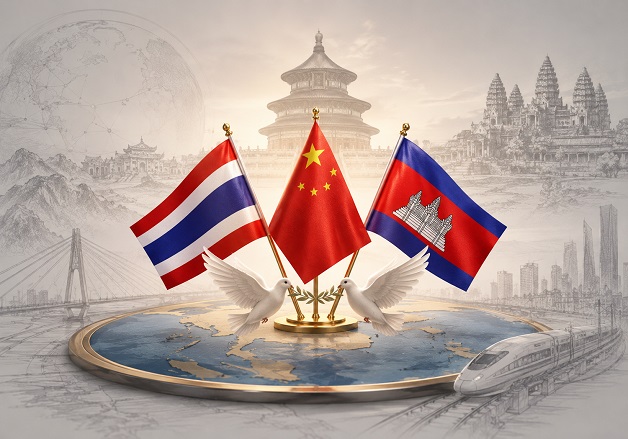
The nearly simultaneous visits of Thai Prime Minister Anutin Charnvirakul and Cambodian Prime Minister Hun Manet to China have drawn regional attention, with observers suggesting Beijing could use the opportunity to encourage dialogue between the two Southeast Asian neighbors amid lingering border tensions.
Although both leaders are travelling primarily for bilateral engagements and to attend the 2026 World Artificial Intelligence Conference (WAIC) in Shanghai, their presence at the same high-profile event has fueled speculation that China may quietly revive its efforts to facilitate communication between Bangkok and Phnom Penh.
China has consistently emphasized that disputes between Thailand and Cambodia should be resolved through peaceful negotiations. In late 2025, Beijing hosted a trilateral meeting involving the foreign ministers of China, Thailand and Cambodia, where it expressed its willingness to support dialogue while maintaining that it would not interfere in bilateral affairs. That approach reflects China’s broader diplomatic strategy of promoting regional stability without publicly assuming the role of a formal mediator.
Beyond regional diplomacy, Anutin’s visit underscores the deepening strategic partnership between Thailand and China. Marking the 51st anniversary of diplomatic relations, the visit includes discussions on trade, investment, technology, artificial intelligence, agriculture, public health and security cooperation. Planned meetings with President Xi Jinping, Premier Li Qiang and other senior Chinese leaders, alongside the signing of multiple cooperation agreements, highlight the growing scope of bilateral engagement.
The inclusion of economic initiatives, including the Thailand-China (Sichuan) Investment and Economic Forum and expanded investment promotion, also reflects both countries’ focus on strengthening economic resilience amid evolving regional and global conditions.
For Cambodia, participation in the AI conference and continued engagement with China further demonstrates Beijing’s central role as one of Phnom Penh’s closest strategic and economic partners.
Whether the parallel visits lead to renewed diplomatic engagement between Thailand and Cambodia remains uncertain. However, they illustrate China’s increasing importance as a regional convening power capable of creating opportunities for dialogue while advancing its own broader economic and geopolitical interests in Southeast Asia.