Staff Correspondent, Dhaka:
Chinese investment in Bangladesh’s Export Processing Zones (EPZs) is increasingly moving beyond the traditional garment sector, signaling a broader transformation in the country’s export-oriented manufacturing landscape. The latest investment commitments suggest Bangladesh is emerging as a preferred destination for higher-value industries as global supply chains continue to diversify.
According to the Bangladesh Export Processing Zones Authority (BEPZA), Chinese companies accounted for nearly two-thirds of the $717.71 million in proposed investments secured during the 2025-26 fiscal year. Of the 36 companies signing land lease agreements, 23 Chinese-owned or Chinese joint-venture firms pledged almost $499 million, making China by far the largest foreign investor in Bangladesh’s EPZs.
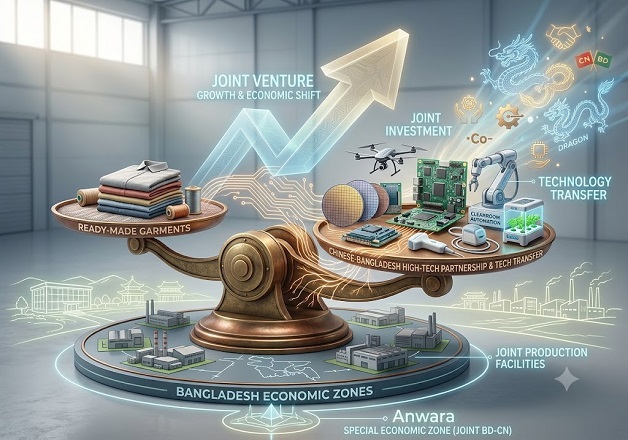
The composition of these investments marks a significant shift. While ready-made garments remain important, Chinese manufacturers are increasingly targeting sectors such as semiconductors, drones, electronics, medical devices, logistics, copper products and automated hydroponic systems. The diversification reflects Bangladesh’s growing appeal as manufacturers seek alternative production bases amid changing global trade dynamics and supply-chain realignment.
The momentum has been reinforced by Prime Minister Tarique Rahman’s recent visit to China, during which several investment agreements covering economic zones, industrial parks and business cooperation were signed. More importantly, discussions with Chinese corporations generated expressions of interest worth $9.21 billion, indicating substantial long-term investment potential, although authorities acknowledge that converting proposals into operational projects remains the real challenge.
Government agencies, including BIDA and BEZA, have responded by establishing dedicated investor support mechanisms, planning a representative office in China and accelerating the development of the Chinese Economic and Industrial Zone in Anwara. These initiatives are designed to strengthen investor confidence and improve project implementation.
If successfully realized, the current pipeline of Chinese investments could accelerate Bangladesh’s transition from a labor-intensive manufacturing hub to a more technology-oriented industrial economy. However, sustaining this momentum will depend on policy continuity, infrastructure readiness, efficient land allocation and regulatory predictability. The next phase will not be measured by investment announcements alone but by how quickly these commitments are translated into factories, exports, employment and technology transfer.