Anwar Shahadat
Recent developments in Bangladesh highlight a familiar but unresolved question: how far should the state go in regulating information once it is labeled misinformation?
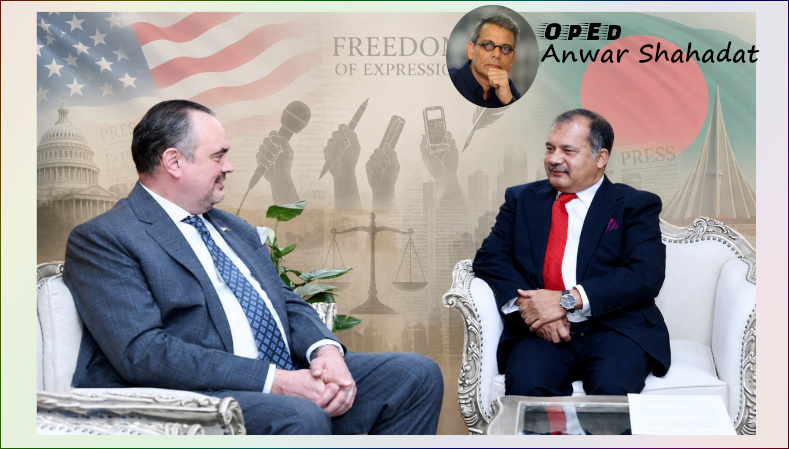
In Dhaka, a meeting between US Ambassador Mr. Brent T. Christensen and Bangladesh’s Information Minister Mr. Zahir Uddin Swapon focused on freedom of expression, information flow, and rising concerns over misinformation and disinformation. While the discussion appeared routine, it reflected a shared concern—though not a shared approach—between Washington and Dhaka on how to deal with the growing information crisis.
Within days, Bangladesh’s representative at the United Nations took the issue to a global stage. At the UN Committee on Information, Bangladesh called for stronger international action against misinformation, disinformation, and hate speech. At the 48th UN session, Ambassador Salahuddin Noman Chowdhury warned that the misuse of AI and digital platforms is deepening divisions and eroding public trust.
Taken together, these statements suggest an apparent alignment in language and concern between Bangladesh’s domestic leadership, its UN representation, and the United States. But surface agreement should not be confused with policy convergence. The real divide is not whether misinformation is harmful—it is how it should be defined, regulated, and controlled.
This is where the contrast between the United States and Bangladesh becomes politically significant.
Freedom of the press is widely promoted as a universal democratic value. In practice, however, it is far from uniform. Both the United States and Bangladesh formally support free expression, but they operate on fundamentally different assumptions about the role of the state in managing speech.
In the United States, press freedom is anchored in the First Amendment, which sets a very high barrier against government interference. Even offensive, misleading, or false speech is generally protected unless it meets narrow legal thresholds such as defamation or direct incitement to violence. The guiding principle is that the state poses a greater risk to free expression than expression itself. Harmful speech is expected to be countered not by restriction, but through more speech—debate, fact-checking, and public accountability.
Bangladesh follows a different model. Its Constitution guarantees freedom of expression but subjects it to “reasonable restrictions” in the interests of national security, public order, and morality. In practice, this creates broader space for state intervention. Laws such as the Digital Security Act and related frameworks demonstrate how terms like “misinformation” or “anti-state activity” can be interpreted flexibly, sometimes encompassing legitimate criticism alongside harmful content.
This legal difference has direct consequences for journalism.
In the United States, journalism operates with institutional confidence. The press is expected to challenge authority, investigate power, and publish without fear of routine legal retaliation. In Bangladesh, however, journalism operates under greater uncertainty. Legal ambiguity, political sensitivity, and the risk of punitive action often encourage caution. As a result, self-censorship becomes not an exception but a survival mechanism.
Nowhere is this contrast more visible than in how misinformation is addressed.
In the United States, misinformation is largely treated as a social and technological problem. The state plays a limited role due to constitutional constraints, while responsibility is distributed across media organizations, technology platforms, researchers, and civil society. The system is imperfect, but its instinct is restraint.
In Bangladesh, misinformation is increasingly treated as a governance and security issue. This shift is critical. Once misinformation becomes a matter of state authority, regulatory boundaries tend to expand quickly and unevenly. The line between protecting public order and suppressing dissent can become blurred, especially when definitions remain broad and enforcement is discretionary.
Supporters of stronger regulation argue that countries like Bangladesh cannot afford the risks of unrestricted speech. This argument is not without merit in fragile information environments. However, it also carries a structural danger: when the state becomes the primary arbiter of truth, regulatory tools designed to address misinformation can easily extend to criticism, opposition voices, and inconvenient reporting.
At the same time, it would be misleading to present the United States as a model of absolute free expression. It is not. Defamation laws, national security restrictions, and private platform moderation all impose limits. However, these restrictions are narrowly defined, frequently challenged, and subject to strong judicial oversight. The default assumption still leans toward protecting speech rather than restricting it.
This difference is not merely legal—it is philosophical. One system is built on the presumption that speech must be protected from state power. The other is built on the assumption that speech must be managed when risks are considered significant.
Neither approach is without cost. Unrestricted speech can amplify harm, while excessive control can suppress legitimate discourse. The real distinction lies not in the presence of risk, but in where trust is placed: in the state, or in public debate.
Seen from this perspective, recent developments in Dhaka and its engagement with the United States and the United Nations are not just diplomatic alignment. They reflect a deeper internal debate within Bangladesh’s governance model: whether information should be primarily regulated or primarily contested in the public sphere.
There is, at least rhetorically, some reason for cautious optimism. The Information Minister’s liberal political background and the Prime Minister’s long exposure to Western political environments suggest an awareness of these tensions. But awareness alone does not resolve structural pressures. In politically sensitive contexts, concerns about misinformation can easily justify broader controls over speech.
Ultimately, the core dilemma remains unchanged. The challenge is not whether misinformation exists—it clearly does—but whether the response strengthens public trust—or quietly undermines it.
Because in the end, press freedom is not defined by official commitments. It is defined by how those commitments hold up when pressure rises.