Special Correspondent, Dhaka:
Bangladesh’s renewed commitment to deepen economic cooperation with Japan through the Bay of Bengal Industrial Growth Belt (BIG-B) initiative presents an opportunity to strengthen industrial capacity, diversify exports and establish the country as a regional trade and logistics hub. However, translating this ambition into sustainable economic gains will depend on effective implementation, investment reforms, and careful management of national interests.
Discussions during Prime Minister Tarique Rahman’s visit to Tokyo have renewed attention to BIG-B as a framework for infrastructure development, industrial expansion and regional connectivity. The initiative seeks to connect Bangladesh’s geographical advantages with productive industries, modern transport networks and stronger integration into regional and global supply chains.
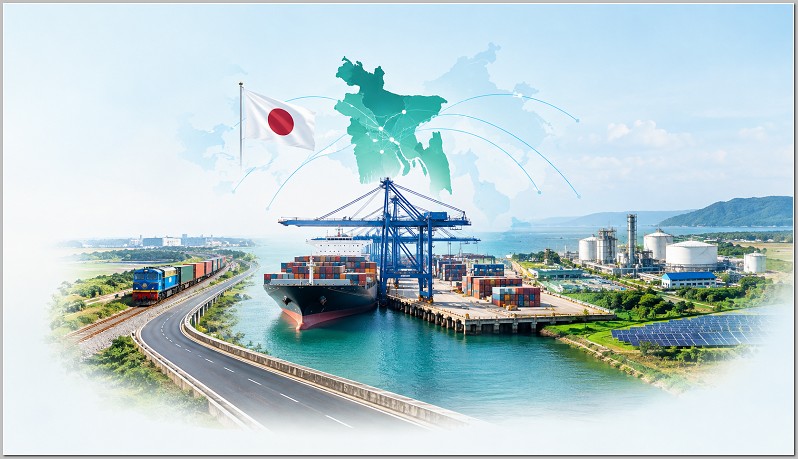
At the center of this vision is the proposed deep-sea port at Matarbari in Cox’s Bazar. As Bangladesh’s maritime trade expands, the country needs port infrastructure capable of supporting larger vessels and improving cargo-handling efficiency. Matarbari could strengthen maritime connectivity and make Bangladesh more attractive to manufacturers seeking reliable access to imported raw materials and international markets.
Yet a deep-sea port alone cannot deliver an industrial transformation. Its economic value will depend on complementary investments in roads, railways, energy supplies, customs services and industrial facilities. The Moheshkhali–Matarbari Integrated Infrastructure Development Initiative (MIDI), supported by Japanese technical cooperation, offers a framework for coordinating these investments.
BIG-B could also help Bangladesh reduce its longstanding dependence on ready-made garments (RMG). Better infrastructure and Japanese technological expertise could encourage investment in electronics, pharmaceuticals, automotive components, agro-processing and light engineering. The Araihazar Special Economic Zone demonstrates the potential of combining Japanese cooperation with industrial infrastructure.
Nevertheless, attracting investment requires more than land and transport facilities. Regulatory predictability, reliable electricity, skilled workers, access to finance and efficient public administration will remain essential to investors’ decisions. Domestic enterprises must also gain opportunities to participate in emerging industrial supply chains.
Regional connectivity presents another opportunity. Bangladesh could provide improved maritime access for India’s northeastern states and facilitate trade with Nepal and Bhutan. Such arrangements could generate port revenues, expand logistics services and encourage cross-border industrial cooperation. Their success, however, would require commercially viable agreements that protect Bangladesh’s economic interests.
Japan’s partnership also carries strategic significance as Bangladesh balances relations with China, India and the United States. Dhaka’s priority should be to evaluate cooperation according to its contribution to economic development, technology transfer and financial sustainability, rather than geopolitical competition.
Environmental protection and energy security will be equally important. Industrial expansion must account for imported-fuel costs, coastal ecosystems, fisheries and climate resilience. Greater energy efficiency and renewable power could help strengthen the initiative’s long-term sustainability.
Ultimately, BIG-B’s success will depend on execution rather than announcements. Transparent procurement, realistic project assessments, institutional coordination and a stable investment climate will be critical. If Bangladesh can connect infrastructure development with export diversification, employment and domestic value addition, BIG-B could become a foundation for broader economic transformation. Otherwise, substantial investment may produce infrastructure without delivering its full promised benefits.