By AIP Wire Staff, New York, Dhaka.
Political and security pressures are continuing to build across Southeast Asia as Myanmar’s prolonged conflict creates new challenges for neighboring countries and the Association of Southeast Asian Nations (ASEAN).
The latest concern follows a deadly airstrike in Myanmar’s Rakhine State. The September 28 attack in Kyauktaw killed about 50 people and wounded dozens, according to local sources cited by Reuters. The United Nations has also expressed concern over the reported civilian casualties.
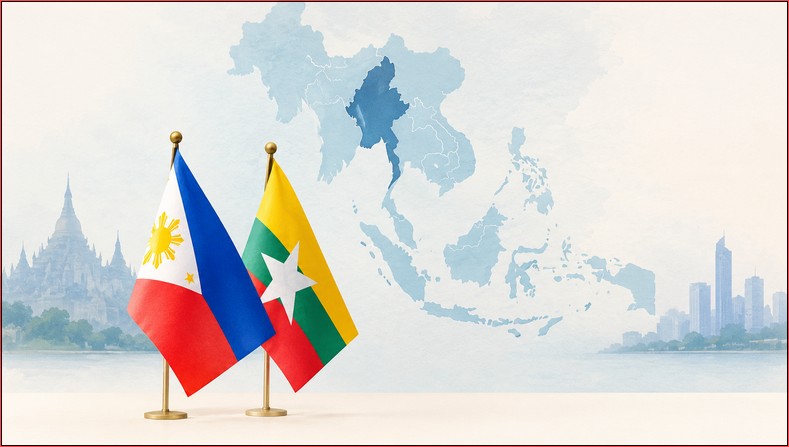
The Philippines, which currently holds the ASEAN chair, has said it is closely monitoring the situation. Manila expressed concern over the deaths, injuries, and destruction and said it was prepared to facilitate discussions within ASEAN on ways to assist Myanmar.
The Philippines also emphasized that ASEAN would continue to follow its consensus-based approach and work toward a solution that is Myanmar-owned and led.
The response comes at a difficult time for the regional organization. Myanmar has remained in conflict since the military takeover in 2021, with the military fighting armed groups across several parts of the country. The conflict has caused widespread displacement and a growing humanitarian crisis. Reuters reported that more than 3.5 million people have been displaced.
Rakhine State presents an additional challenge because of its location along Myanmar’s western border with Bangladesh. Continued fighting there has consequences beyond the immediate conflict zone, including concerns about civilian safety, displacement, and humanitarian access.
The regional situation is also being affected by developments involving displaced Myanmar nationals. Malaysia recently began returning about 1,500 Myanmar nationals under a repatriation arrangement with Myanmar. The move has drawn concern from the United Nations and other organizations over whether conditions in Myanmar are safe for returns.
These developments put additional attention on ASEAN’s role. The organization has repeatedly sought a regional diplomatic approach to Myanmar, but its consensus-based system means that member states must work through differing positions.
For the Philippines, the challenge now is to keep regional discussions moving while maintaining ASEAN’s established approach. The offer to facilitate further discussions could provide another channel for member states to consider humanitarian assistance and possible diplomatic steps.
What comes next will depend partly on developments inside Myanmar and partly on how ASEAN members respond to the continuing violence.
For Southeast Asia, the issue is no longer limited to Myanmar’s internal conflict. The continuing violence, displacement, and cross-border effects are increasingly becoming a regional concern.
The coming weeks may therefore bring greater attention to ASEAN’s ability to maintain dialogue, coordinate humanitarian responses, and keep the Myanmar issue on the regional agenda.
For now, the Philippines’ latest statement signals that ASEAN is continuing to engage, even as the conflict remains unresolved.