Senior Correspondent, Dhaka:
India’s campaign for a permanent seat on the United Nations Security Council has gained fresh diplomatic momentum after the four Visegrad Group (V4) countries expressed support for New Delhi’s bid, highlighting the growing European dimension of India’s push for a larger role in global decision-making.
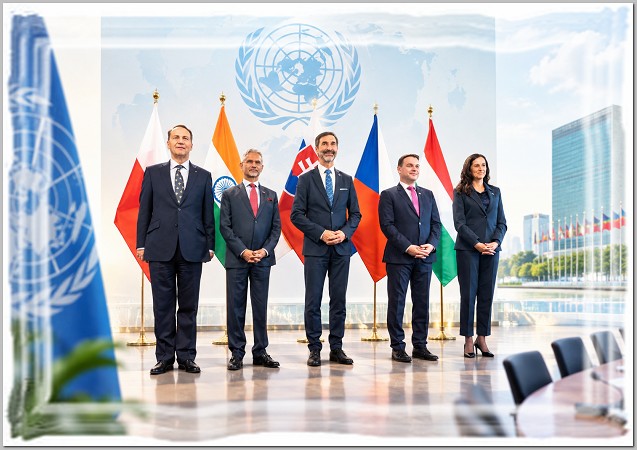
Slovak Foreign Minister Juraj Blanár said India, as a leading country of the Global South and an emerging Indo-Pacific power, should become a permanent member of the Security Council. The position was voiced during the first high-level V4+India meeting on the sidelines of the 81st UN General Assembly in New York.
The V4—comprising Poland, Hungary, Slovakia, and Czechia—represents four European voices supporting India’s longstanding demand for greater representation in the UN’s most powerful body. For New Delhi, such endorsements are significant because its campaign increasingly depends on building a wider coalition beyond traditional partners in Asia, Africa, and the developing world.
However, the latest backing also underlines the distinction between political support and institutional change. The Security Council remains structured around five permanent members—China, France, Russia, the UK, and the US—while 10 non-permanent members serve two-year terms. Expanding permanent membership would require agreement on a complex UN reform process involving competing regional and national interests.
The V4 meeting therefore serves a broader diplomatic purpose for India. Alongside the Security Council issue, New Delhi and the four European countries agreed to deepen political, economic, and strategic cooperation, including regular foreign-ministerial meetings and an annual business forum.
Jaishankar also highlighted cooperation in defense, technology, innovation, space, connectivity, and people-to-people exchanges. These areas provide India with additional channels to consolidate European partnerships while strengthening its wider diplomatic profile.
The timing is also notable as India prepares its campaign for a non-permanent Security Council seat for 2028-29. While V4 backing adds another layer of international support, India’s larger objective remains more difficult: turning broad political endorsements into a sufficiently strong consensus for fundamental Security Council reform.