
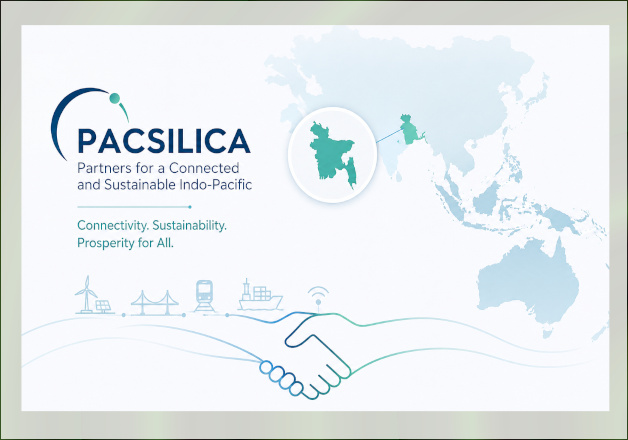
AIP Wire Analysis, New York. Sergio Gor, the US Special Envoy for South and Central Asia, has been quoted as saying that Bangladesh may help to Pax Silica. Because they imply that Washington regards Bangladesh as a possible partner in a larger economic and technical project. It suggests that the relationship between two countries is more than just a development or security partnership.
Pax Silica is a US-led project created by the State Department to strengthen trustworthy supply chains in artificial intelligence, semiconductors, vital minerals, advanced manufacturing, energy inputs, logistics, and other strategic industries. The program aims to bring together governments and the commercial sector to create resilient and secure technology ecosystems among trusted partners.
Although Bangladesh is not currently a Pax Silica signatory, Sergio Gor’s reported comments suggest that Washington believes Dhaka has the potential to play a role in the initiative as the country expands its technology and manufacturing sectors. His visit to Bangladesh also came at a time when the United States is seeking to deepen bilateral ties while closely following Bangladesh’s evolving foreign policy and growing engagement with China.
For Bangladesh, participation in or cooperation with Pax Silica could provide several potential benefits. The most immediate opportunity would be attracting greater U.S. and allied investment in high-technology industries. As multinational companies seek to diversify supply chains beyond a limited number of manufacturing hubs, Bangladesh could position itself as a destination for electronics assembly, semiconductor packaging and testing, data infrastructure, and other advanced manufacturing activities
Bangladesh could also benefit from technology transfer, workforce development, and research partnerships. Pax Silica places strong emphasis on innovation, artificial intelligence, semiconductor ecosystems, and cooperation between governments and private industry. Participation could create opportunities for Bangladeshi universities, engineers, startups, and technology firms to connect with international partners and emerging supply chains.
The timing is also significant because the Bangladeshi government has recently identified semiconductors as a future driver of economic growth beyond the ready-made garments sector. Prime Minister Tarique Rahman recently described the semiconductor industry as a potential next major engine of national economic development, indicating that Dhaka is already seeking to develop capabilities in this field.
From Washington’s perspective, Bangladesh’s strategic location in the Bay of Bengal, its large workforce, expanding digital economy, and growing manufacturing base make it an increasingly important partner in efforts to build resilient supply chains across the Indo-Pacific region. Rather than concentrating production in only a few countries, the United States has been encouraging trusted partners to participate in diversified industrial networks
At the same time, any future Bangladeshi involvement in Pax Silica would likely require significant domestic reforms. These could include improving infrastructure, strengthening intellectual property protection, expanding reliable energy supplies, investing in advanced technical education, improving cybersecurity standards, and creating policies that encourage high-value foreign investment. These are factors that international technology companies typically consider before making long-term investment decisions.
Bangladesh would also need to continue balancing its relationships with major powers. Dhaka maintains close economic ties with China while simultaneously seeking stronger cooperation with the United States, Japan, Europe, and other partners. Participation in initiatives such as Pax Silica would not necessarily require Bangladesh to abandon existing partnerships, but it would require careful diplomacy to preserve its long-standing policy of maintaining constructive relations with multiple countries
While no announcement has been made that Bangladesh will formally join Pax Silica, Sergio Gor’s reported remarks indicate that Washington views Bangladesh as a country capable of contributing to future technology supply chains. If Bangladesh succeeds in developing its semiconductor, electronics, and digital industries while attracting international investment, cooperation under initiatives such as Pax Silica could support the country’s broader goal of moving toward a more technology-driven economy