Senior Correspondent, Dhaka:
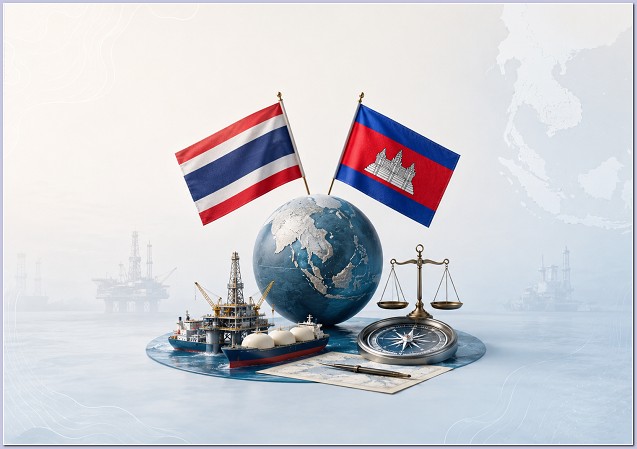
The Thailand-Cambodia UNCLOS conciliation process marks a significant diplomatic effort to resolve one of Southeast Asia’s longest-running maritime disputes, but differing national priorities suggest the negotiations may prove more complex than the legal mechanism itself. As both countries move closer to establishing a five-member conciliation commission under the United Nations Convention on the Law of the Sea (UNCLOS), the process offers an opportunity for dialogue rather than a binding settlement.
Bangkok and Phnom Penh have each appointed two international experts, who are now tasked with selecting a neutral chair by August 14 after extending the original deadline. Once constituted, the commission will examine competing maritime claims in the Gulf of Thailand and issue non-binding recommendations aimed at facilitating a negotiated agreement.
However, the Thailand-Cambodia UNCLOS conciliation faces a fundamental political challenge. Thailand insists the process should focus exclusively on maritime boundary delimitation and determining whether overlapping claims legally exist. Only after sovereignty issues are clarified, Bangkok argues, should discussions on joint resource development begin.
Cambodia, by contrast, sees the mechanism as a pathway not only to settle maritime boundaries but also to unlock offshore oil and gas reserves estimated at 11-12 trillion cubic feet of natural gas and potentially worth up to US$300 billion. Amid global energy uncertainty and growing domestic demand, Phnom Penh considers early progress on resource-sharing vital to strengthening long-term energy security and attracting foreign investment.
The divergence reflects a broader contrast between legal and economic priorities. Thailand remains cautious about any arrangement that could be interpreted as compromising sovereignty, particularly as it also raises concerns over Cambodian coastal developments and competing maritime claim lines. Cambodia, meanwhile, argues that delaying joint development could reduce investor confidence as global financing for fossil fuel exploration becomes increasingly constrained.
The UNCLOS conciliation mechanism, successfully used by Timor-Leste and Australia, demonstrates that negotiated settlements remain possible even in sensitive maritime disputes. Yet unlike judicial arbitration, the commission cannot impose a legally binding outcome. Its effectiveness will therefore depend largely on political will rather than legal authority.
Ultimately, the conciliation process may reduce tensions and establish a structured framework for negotiations. Whether it evolves into a lasting maritime settlement or becomes another prolonged diplomatic exercise will depend on the willingness of both governments to reconcile sovereignty concerns with the economic opportunities offered by shared offshore resources.