
Sadik Sagar, Dhaka:
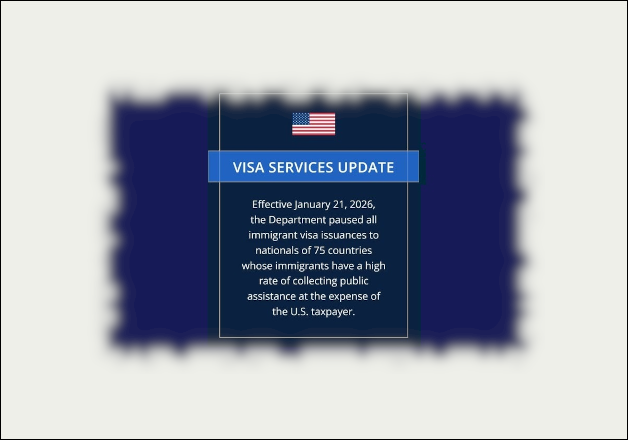
The decision by the United States Embassy in Dhaka to suspend the issuance of immigrant visas for Bangladeshi nationals marks a significant development in bilateral mobility dynamics, highlighting Washington’s growing emphasis on economic self-sufficiency among migrants. Framed around concerns over the relatively high usage of public welfare benefits, the move reflects a broader recalibration of immigration screening priorities rather than a blanket restriction on Bangladeshi travel.
According to the embassy, the pause is intended to allow the United States Department of State to conduct a comprehensive review of its vetting procedures. The underlying rationale—ensuring that incoming immigrants do not become a “public charge”—aligns with longstanding principles in US immigration policy, but its targeted application to Bangladesh suggests data-driven concerns specific to this migrant group. While the exact metrics behind the “high rate” of welfare usage have not been publicly detailed, the implication is that existing screening mechanisms may not be adequately filtering economic risk factors.
Importantly, the suspension is limited in scope. It does not apply to nonimmigrant visas, including student and tourist categories, thereby preserving key channels of educational exchange and short-term travel. This distinction indicates that the US is not seeking to curtail people-to-people ties altogether, but rather to tighten pathways associated with permanent residency and long-term fiscal responsibility.
From a Bangladeshi perspective, the development raises both immediate and structural concerns. In the short term, prospective immigrants—particularly those pursuing family reunification or employment-based migration—face uncertainty and potential delays. Over the longer term, the issue may prompt Dhaka to examine the socioeconomic profiles of its migrant flows and engage Washington in dialogue to address perceived risks. Failure to do so could result in prolonged restrictions or stricter eligibility thresholds.
Diplomatically, the move introduces a sensitive dimension to Bangladesh–US relations. While not overtly punitive, the policy implicitly signals concerns about migrant integration outcomes, which could be perceived as reputationally challenging. At the same time, it offers an opening for technical cooperation on migration governance, including data sharing, pre-departure orientation, and financial preparedness of migrants.
The decision also reflects a wider global trend of destination countries increasingly linking immigration access to economic performance indicators. In this context, Bangladesh’s growing overseas workforce—traditionally concentrated in the Middle East—faces a different set of expectations in Western destinations, where welfare systems and fiscal sustainability are central political issues.
Ultimately, the visa pause should be seen less as an abrupt policy shift and more as part of an evolving framework of selective migration management. Its duration and long-term implications will largely depend on the outcomes of the US review process and the extent to which both sides can address underlying concerns through policy adjustments and diplomatic engagement.