AIP Wire Desk, Dhaka:
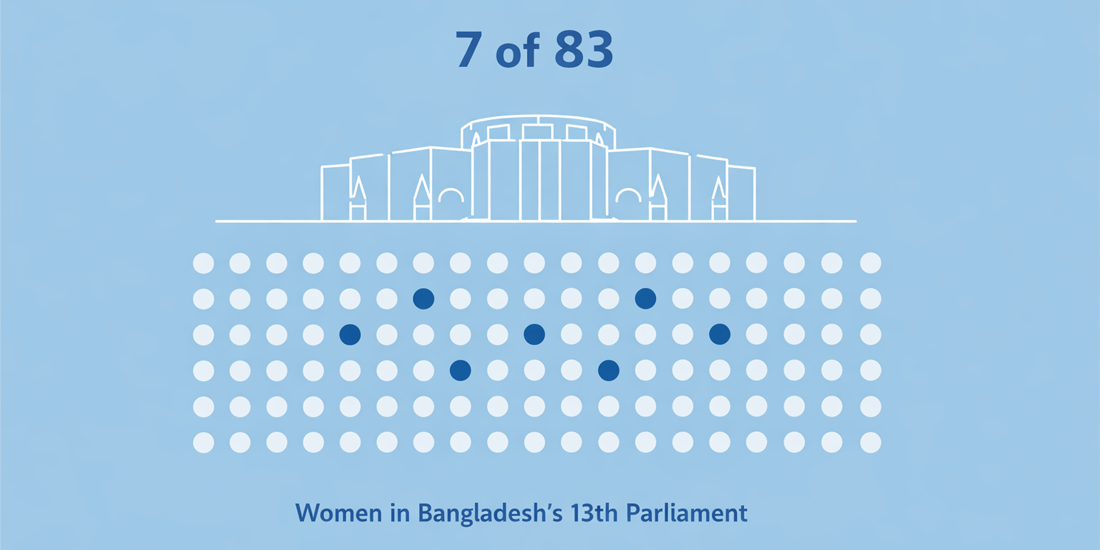
Women’s political representation in Bangladesh has come under renewed scrutiny after just seven female candidates secured seats in the country’s 13th national parliamentary election, according to multiple international media reports.
India’s Hindustan Times reported that of 83 women who contested the election, only seven were elected. Six of the winners were candidates of the Bangladesh Nationalist Party (BNP), while one won as an independent. The success rate for female candidates stood at just over 8%, underscoring the stark gap between participation and victory. Overall, women accounted for roughly 4% of total candidates.
Echoing similar figures, The Pioneer noted that the majority of the seven elected women won through direct party competition. However, the small share of female nominees highlighted what observers describe as the continued reluctance of major political parties to prioritise women in nomination processes.
Meanwhile, National Herald described the outcome as a “record low female representation”, reporting that although 109 women contested the polls, only seven emerged victorious. The outlet also pointed out that several Islamist parties fielded no female candidates at all, further narrowing the space for women’s participation in mainstream politics.
In a pre-election analysis, Britain’s The Guardian warned that the rise of Islamist political forces and rhetoric opposing women’s leadership could make the political environment increasingly challenging for women. The report characterised the election as a critical test for women’s rights and public participation.
Compared with previous parliaments, the decline in directly elected female lawmakers has drawn concern among analysts. While Bangladesh maintains constitutionally reserved seats for women, the number of women winning general constituencies remains limited, reflecting what critics describe as structural barriers within party politics, social attitudes and electoral dynamics.
Taken together, international coverage suggests that women’s presence in Bangladesh’s electoral politics remains not only numerically marginal but also constrained by deeper institutional and ideological challenges.