By Sadik Sagar, Dhaka.
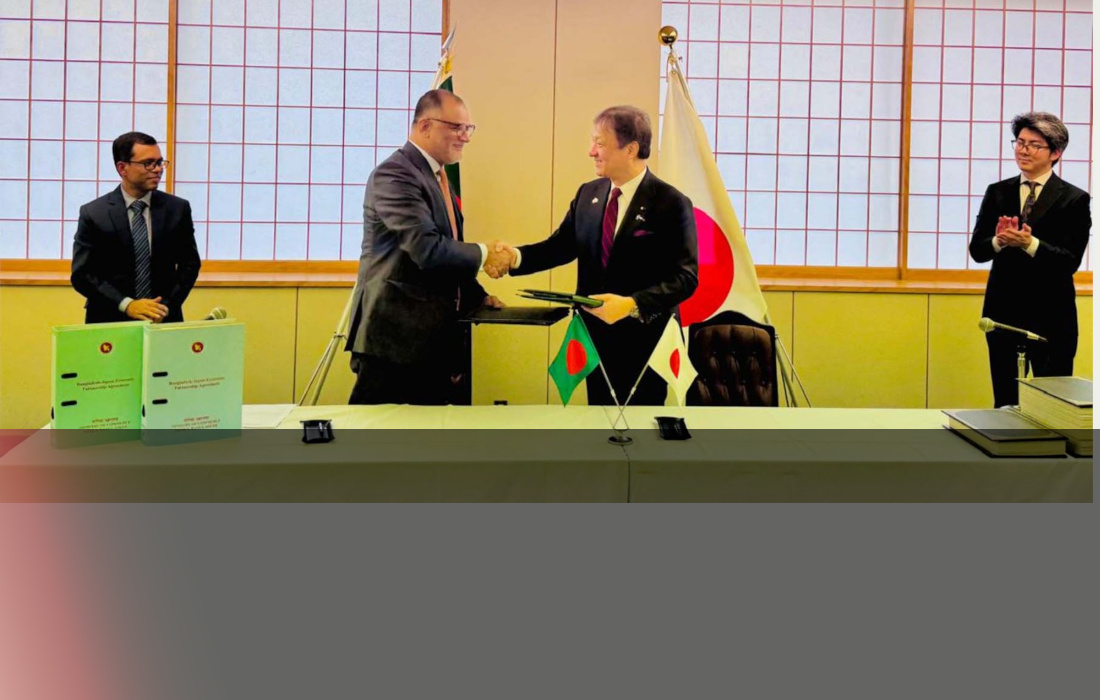
Bangladesh’s newly signed Economic Partnership Agreement (EPA) with Japan marks a significant step in strengthening bilateral economic ties, offering fresh momentum for trade expansion, labour mobility and long-term cooperation, while imposing only a modest fiscal cost of less than Tk 20 crore annually in forgone import duties on Japanese goods. At the same time, the deal has generated debate among businesses and analysts over its potential long-term impact on domestic industries and policy space.
Signed on February 6 in Tokyo, the EPA creates a strongly asymmetric trade framework that favours Bangladesh. Under the agreement, Japan will grant immediate duty-free access to 7,379 Bangladeshi products, while Bangladesh will offer similar treatment to only 1,039 Japanese items. The number of Japanese products eligible for duty-free entry will gradually rise over an 18-year period, giving Bangladesh time to adjust to increased competition.
The ready-made garment sector, the backbone of Bangladesh’s export economy, is expected to be a major beneficiary. The agreement allows single-stage transformation, enabling exporters to qualify for zero-duty access even when using imported fabrics—an advantage that addresses a longstanding constraint faced by manufacturers. Bangladesh has also secured a 10-year relaxation in intellectual property rights enforcement, reflecting its LDC status and easing transitional pressures.
Beyond trade in goods, the EPA opens new pathways for Bangladeshi professionals in Japan’s ageing and labour-constrained economy. Skilled workers, including doctors, nurses, caregivers and domestic helpers, are expected to gain improved access to the Japanese labour market, potentially boosting remittance inflows and strengthening people-to-people ties. The services component of the agreement grants Bangladesh access to 120 Japanese sub-sectors, while Japan will gain entry to 98 sub-sectors across 12 sectors in Bangladesh.
The timing of the agreement is strategically significant as Bangladesh approaches graduation from LDC status. While Japan has extended existing LDC privileges for Bangladeshi exports until 2029, the EPA provides a more durable framework for market access and marks Bangladesh’s first comprehensive bilateral trade agreement with a major developed economy.
However, analysts caution that the agreement could expose several domestic industries—such as plastics, glass, light engineering and pharmaceuticals—to intensified competition from duty-free Japanese imports. Mohammad Hafizur Rahman, former director general of the WTO Cell and a member of the EPA negotiation team, told The Business Standard that duty-free entry of Japanese products could undermine local industries lacking comparable scale and technology, while key sectors such as leather did not receive reciprocal duty-free access.
Business leaders also point to structural weaknesses that could limit the deal’s benefits. Syed Ershad Ahmed, president of the American Chamber of Commerce in Bangladesh, told The Business Standard that high logistics costs, limited export diversification, weak research and innovation capacity, and regulatory bottlenecks remain major constraints, adding that trade agreements alone cannot deliver results without reforms in skills development, governance and infrastructure.
Despite these concerns, experts believe the EPA could significantly strengthen Bangladesh’s global trade position if supported by comprehensive reforms in logistics, skills, regulation and innovation.
As Bangladesh moves toward a post-LDC era, the Japan EPA underscores both the promise and the pressures of deeper integration with advanced economies.