Sadik Sagar, Dhaka.
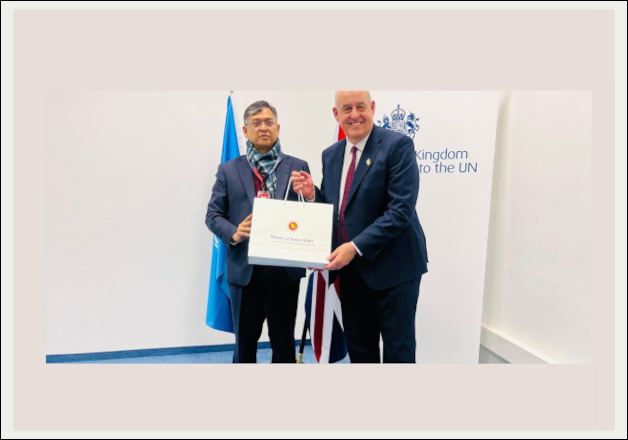
In a move reflecting both domestic reform priorities and pressing regional concerns, Bangladesh has sought enhanced cooperation from the United Kingdom on police modernisation and the repatriation of Rohingya refugees. The discussion took place between Salahuddin Ahmed and Lord Hanson on the sidelines of the Global Fraud Summit 2026 in Vienna.
At one level, the engagement underscores Bangladesh’s ongoing effort to reform its law enforcement institutions. By seeking technical assistance and training from the UK—widely regarded for its professional policing standards—Dhaka appears to be prioritising institutional accountability, human rights protection, and public trust. This aligns with broader governance goals following the 2026 parliamentary election, as the government attempts to reinforce its reform credentials both domestically and internationally. However, translating such cooperation into tangible outcomes will depend on sustained political will, resource allocation, and the ability to adapt foreign models to local realities.
At another level, the Rohingya issue remains central to Bangladesh’s foreign policy calculus. Hosting over a million displaced people, Bangladesh continues to push for safe and sustainable repatriation to Myanmar. By urging the UK to exert international pressure, Dhaka is signalling the need for stronger global engagement, particularly from influential Western partners. Yet, the complexity of the crisis—rooted in Myanmar’s internal dynamics and geopolitical constraints—means that diplomatic support alone may not yield immediate results.
The meeting also highlights a broader strategic convergence between Dhaka and London. Cooperation in counter-terrorism, maritime security, and migration management suggests an evolving partnership that goes beyond traditional development assistance. The UK’s willingness to elevate ties indicates recognition of Bangladesh’s growing regional importance, particularly in the Indo-Pacific context.
Nevertheless, challenges persist. Police reform in Bangladesh has historically faced criticism over implementation gaps, while the Rohingya crisis remains one of the most intractable humanitarian issues in the region. The effectiveness of this renewed engagement will therefore be judged not by diplomatic statements, but by measurable progress in institutional reform and refugee repatriation.
Overall, the dialogue signals intent and opportunity—but its success will hinge on execution in an increasingly complex geopolitical environment.