By Tanvir Rusmat, Dhaka:
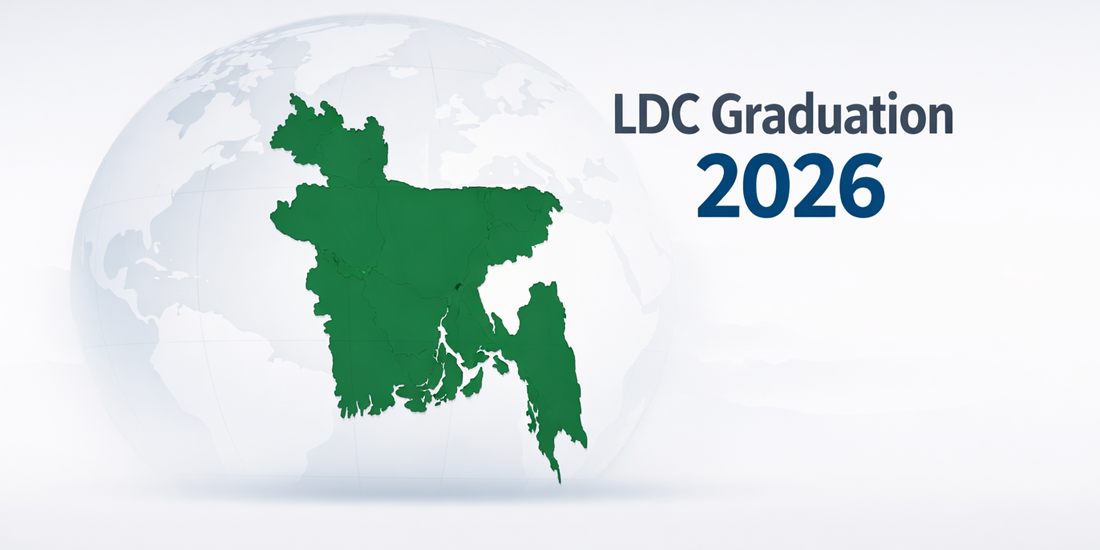
Fresh uncertainty has emerged around Bangladesh’s scheduled graduation from the United Nations’ Least Developed Country (LDC) category on 24 November 2026, after the government formally requested a three-year extension to the timeline. While officials continue to express commitment to the transition process, the request has highlighted concerns over inadequate preparation for the post-LDC economic environment.
Soon after assuming office, the country’s Economic Relations Division (ERD) sent a letter to the Committee for Development Policy (CDP), a UN body that reviews LDC status, seeking to defer graduation until November 2029. The government cited multiple challenges, including post-pandemic economic pressures, global instability linked to the Russia–Ukraine war, weaknesses in the financial sector, political transition, and the ongoing Rohingya refugee crisis.
Officials argue that successive shocks prevented the effective use of the preparatory period and that additional time would help stabilise macroeconomic conditions and complete structural reforms. However, the feasibility of postponement remains uncertain, with analysts divided over whether the request will succeed.
Economist Debapriya Bhattacharya said it may be difficult to justify a delay after Bangladesh had already benefited from an extended preparation window. He emphasised that policy focus should now shift toward implementing the smooth transition strategy, particularly through economic diversification, productivity gains and stronger institutional capacity. He also described the government’s move as akin to pressing a “crisis button”, typically used when a situation risks moving beyond control.
The CDP is expected to review Bangladesh’s request before any final decision is taken at the United Nations General Assembly, where member states would vote on the proposal.
Meanwhile, Mustafizur Rahman, a distinguished fellow at the Centre for Policy Dialogue (CPD), said the government had acted appropriately by submitting the request quickly. However, he noted that diplomatic engagement would now be critical, as support from key partners such as India, China and the European Union could influence the outcome.
Bangladesh has already met the required thresholds for graduation in per capita income, human assets and economic vulnerability indicators across multiple UN assessments. Yet the loss of LDC-linked trade privileges — including duty-free and quota-free access — is expected to create pressure on major export sectors, particularly ready-made garments, which dominate the country’s export earnings.
Business leaders have long warned that securing free trade agreements, obtaining GSP Plus preferences and accelerating export diversification are essential to cushion the transition. The extension request itself suggests that policymakers also recognise gaps in preparedness, despite earlier official assurances that graduation would proceed on schedule.
Analysts broadly agree that leaving the LDC category would represent a historic milestone for Bangladesh’s development trajectory. But they caution that without sufficient preparation, the transition could pose risks to exports, employment and industrial growth. Whether graduation occurs in 2026 or is delayed, they argue, the country’s immediate priority must be faster policy reform, stronger trade diplomacy and sector-specific readiness.
Globally, there are currently 44 countries classified as LDCs — a subset of developing economies identified as having limited structural capacity. Over the next five years, six countries are expected to graduate from the category, including Bangladesh, Laos and Nepal, all currently scheduled for transition in 2026.