
Senior Correspondent, Dhaka:
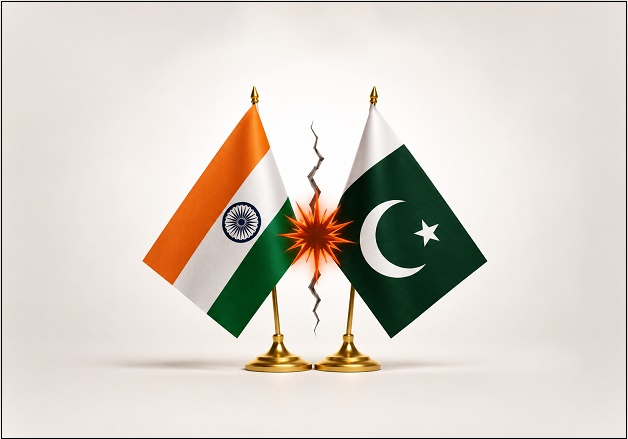
Fresh diplomatic tensions have emerged between India and Pakistan following a deadly attack on a Pakistan Rangers installation in Karachi, highlighting the persistent fragility of bilateral relations and the broader security challenges facing the region. While Pakistan has accused India of supporting the perpetrators, New Delhi has categorically denied the allegations, underscoring the continuing trust deficit between the two nuclear-armed neighbors.
The attack on a Rangers camp in Karachi’s Gulistan-e-Jauhar area killed at least three security personnel and injured four others after assailants detonated explosives at the camp’s main gate before attempting to breach its perimeter. The incident formed part of a series of coordinated militant attacks across Pakistan during the weekend, extending from Karachi to Balochistan, where insurgent groups, including the Baloch Liberation Army (BLA), claimed responsibility for attacks on security installations.
Following the Karachi attack, Pakistan’s Information Minister Mohsin Naqvi alleged that India was backing the attackers. India swiftly rejected the accusation, with External Affairs Ministry spokesperson Randhir Jaiswal describing the claims as “baseless” and urging Pakistan to focus on dismantling militant infrastructure within its own territory instead of attributing responsibility to external actors.
The exchange reflects a familiar pattern in India-Pakistan relations, where major security incidents frequently trigger diplomatic confrontations before conclusive evidence is made public. The absence of independently verified information linking any external state to the Karachi attack means the competing claims remain political positions rather than established facts.
The incident also highlights Pakistan’s increasingly complex internal security environment. Militant violence has surged in recent months across Khyber Pakhtunkhwa, Balochistan and Sindh, driven by multiple armed groups with distinct ideological and separatist agendas. The BLA, in particular, has intensified attacks targeting military personnel and infrastructure, arguing that it is fighting for greater autonomy in Balochistan. At the same time, extremist organizations operating in Pakistan’s western regions continue to pose serious security threats.
Pakistan has responded with expanded military operations, including ground offensives and cross-border strikes near the Afghan frontier, claiming to have killed dozens of militants. However, analysts argue that persistent insurgencies demonstrate the difficulty of addressing deeply rooted political, ethnic and security grievances solely through military means.
For India, the renewed allegations come amid a prolonged period of strained diplomatic engagement, with bilateral dialogue remaining largely suspended. The latest exchange is therefore unlikely to create immediate military escalation, but it may further reduce prospects for confidence-building measures or renewed diplomatic engagement.
Ultimately, the Karachi attack illustrates two parallel realities: Pakistan faces significant domestic security challenges from multiple militant organizations, while the enduring rivalry with India continues to shape official narratives following major acts of violence. Without transparent investigations and sustained diplomatic communication, such incidents risk reinforcing regional mistrust and prolonging one of South Asia’s most enduring geopolitical fault lines.